The Product Manager in the Product Operating Model: Where to Grow for More Impact
The more I talk to Product Managers the more I identify similarities in how their day-to-day looks to what I was doing 8 years ago and had to evolve painfully - back-to-back meetings, long refinement sessions, a backlog that never stops growing, and time to update the roadmap only when someone asks me when this feature will be ready or when the VP asks for it. And we both know that we should be talking to customers, experimenting with solutions, but somehow - there is never time.
My experience with the Product Operating Model presents a different reality, where the product managers are empowered to discover solutions to problems. Problems worth solving. Where outcomes matter more than the actual delivery, and PMs are true partners in creating value. Unfortunately, in many organizations the gap between this vision and daily reality remains big.
But what is actually stopping us, and is there anything we can do about it? The answer is - YES.
The Feature Factory
Honestly, this is the reality we don’t want to admit. Despite adopting agile practices, hiring talented people, and talking about outcomes - a lot of organizations are still running feature factories. Not familiar with the term? Let’s identify it:
Your roadmap is full of solutions instead of problems.
Your success is measured by delivery and velocity.
You are worried more about when Stakeholder X will ask about Feature Y than why the adoption is low and this impacts the business.
You spend most of your time managing the inputs, not shaping the direction.
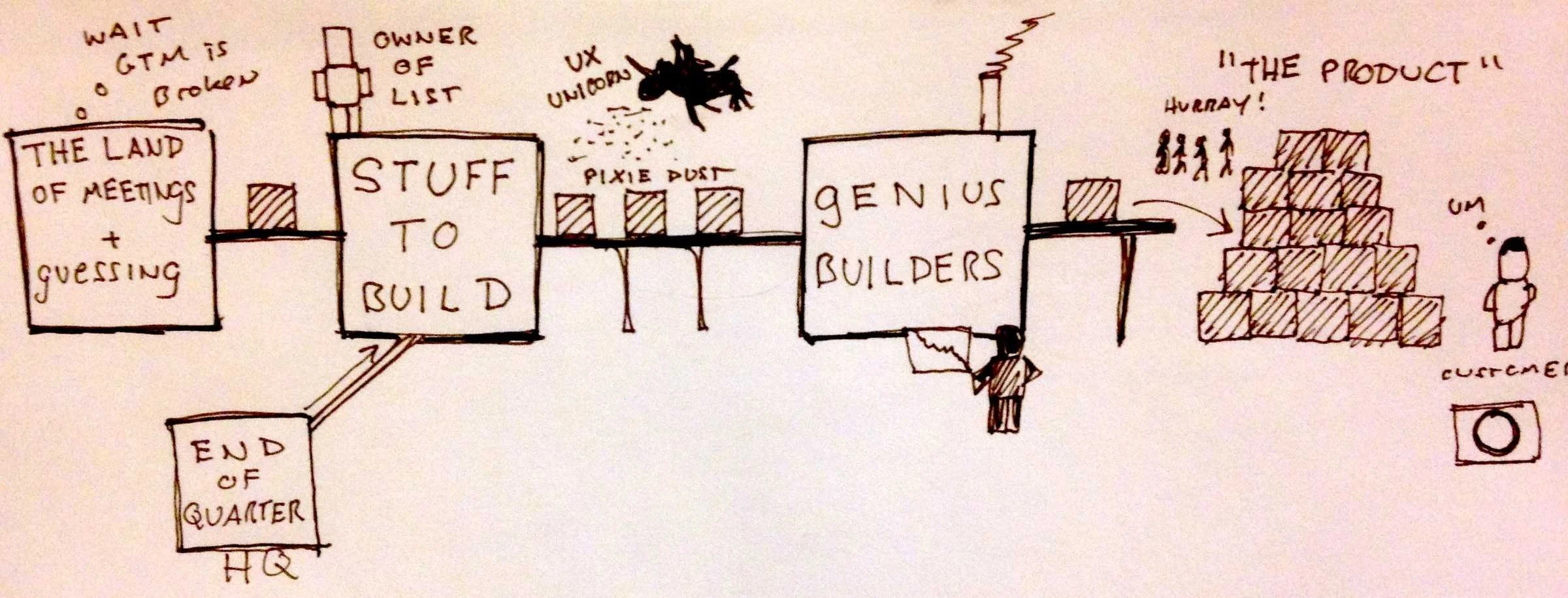
In this way of working, the product manager is the person who takes requirements from stakeholders, translates them to user stories, manages the backlog and ensures the on-time delivery by the team. This is important work, but it is not the product management work in the way the Product Operating Model envisions it.
What is the difference? Let’s start with the core responsibilities or:
Understanding the customers deeply enough to identify which problems are worth solving
Partnering with Design and Engineering to discover solutions that actually work. Not just implementing predetermined features
Being accountable for outcomes and connecting them with the business goals
Your schedule should not only be full of status update meetings, backlog grooming, internal Stakeholder meetings and coordination activities.
This isn’t a personal failing. It is a systemic issue, when organizations reward output over outcomes and the leadership expects detailed roadmaps months in advance. Breaking out requires both individual initiative and organizational change.
If you recognize yourself in what I’ve described - what can you actually do about it? The answer isn’t to wait for the change to happen. It’s to start growing, one small step at a time, reclaiming what is important.
Start with curiosity
When was the last time you spoke DIRECTLY with a customer? How about their problems - not to validate a feature you've delivered or designed, but to genuinely understand their world and around it. It was more than two weeks? This is your first priority! Block time for a customer conversation - this week, next week, ASAP. Get into the meeting openly to discuss their challenges, their context and needs, and why this is important to them.
You do not have access to customers? Go to your manager and understand why. Was it a bad past decision? Are the company worried you won’t be able to handle the meeting and break the relationship? If that is the case - you can learn how to handle such meetings. Shadow Customers Success managers or Account Executives calls, propose help in those calls to build trust.
If there is still a valid business reason for this - be creative. Try behavior analytics tools to understand how your customers use your product, use quantitative questionnaires, take advantage of your Customer Advisory Board, or ask your GTM team for “friendly” or close customers you can talk with. There is always a way, you just need to find it. You are the driver.
Become a student of your industry
The best product managers can hold their own conversations with domain experts. They understand the ecosystem their product operates in, the competitive landscape, the regulatory environment, the trends shaping the industry and customer expectations. You can’t learn this overnight. You need to consistently invest in acquiring it by reading industry publications, attending conferences, and talking to people across the value chain. The deeper the industry expertise, the more credibility you will have when proposing new ideas and approaches.
Reframe your line of talk
Instead of presenting roadmaps and talking about features, start with the problems and outcomes. Instead of asking Stakeholders “what do you want us to build?”, ask “what problems are you facing and trying to solve and how do you know we succeeded?”. This shift may sound small, but it changes how people think about product work gradually. With what agenda your customers attend the meetings - from “when our list of features will be delivered” to “those are the problems we are facing and are important to us”. It opens space for discovery.
Experimentation is a must
You don’t need permission to run small experiments. You will be rewarded if you do so, especially when you share your findings about where we were wrong. Before committing to a major feature, you can test core assumptions with a prototype! With today's technology AI can help us build it in minutes - and don’t worry about the design system - this is not the focus. Before building an entire workflow, you can validate its demand with a simple landing page. Experimentation doesn’t require a big budget or organizational transformation. It requires a mindset that values learning over certainty.
Build alliances
You are not alone in your desire to work differently. Design and engineering often share the feature factory frustration. GTM teams often are slated with customers and cannot keep up with the evolving customer and industry needs - often focused on renewals, de-escalations and others. They will be your best partner once seeing you solved an important problem the customer had and never talked about, or you wanted them about. Demonstrating better outcomes through a more discovery-oriented approach will influence broader change in your organization.
Measure what matters
Trading only delivery metrics like velocity, story points completed, features shipped? You are reinforcing the feature factory. Start introducing outcome metrics, events informally. What customer behavior are you trying to change? What business results are you aiming for? Which feature adoption are you increasing? Once you can show that your discovery work leads to better outcomes, you are building a case for more investment in this approach.
You cannot make everyone happy
And this is a fact. If you are trying to, what are your priorities? What is your strategy? What is the vision? You need focus, and this is hard. Many companies claim they do have a focus and then pull a list of 30 initiatives that are all over the place. This is not focus, it is a lack of Strategy that supports the Vision of the company. If you don’t know what the strategy is in the sense of 1-2-3, go immediately ask your product leader. If you are this person - start working on, but don’t forget - the strategy supports the product vision with focus on 1-2 big bets.
The Product Operating Model is not only a different way of organizing work. It is a mindset shift. It is a responsibility change - you need to take it. It is a fundamentally different concept of what product management means. Moving from coordinator to true product leader doesn’t happen through a single transformation initiative, but through consistent, deliberate choices of - understanding customers deeply, questioning assumptions, and experimenting rather than executing blindly.
The organizations doing this right build better products, and the PMs who embrace the shift have more impact and more fulfilling careers. The path forward? If you want to be a product manager in the Product Operating Model sense, you have to start acting like one regardless of whether your organization has fully arrived there yet. And don’t forget - The Head of Product is measured by its weakest Product Manager.
Don't be this person.
author: Mihail Kyosev