
My Approach to Coaching
I did not start as a coach. I started as a software engineer, then a product manager, then a line leader and as part of my job I had to running trainings for teams and leaders internally inside the companies I was working for. I was good at it, and I enjoyed it, but over time I noticed something that bothered me. People would leave a workshop energised, full of new ideas, equipped with frameworks and tools.
Then go back to work and nothing would change. Knowledge alone was not enough to change behaviour. The problem was never a lack of information.
Reflecting on that changed my career. I went from teaching and managing people what to do to helping them figure out themselves.
Why CoTransition?
The name CoTransition is not a branding exercise (well to some extend it is :-) ).
Change is external. A new structure, a new strategy, a new tool, a new role. Transition is what happens inside people. It is the psychological process of letting go of the old, navigating the uncertainty in between, and finding your footing in something new. This distinction comes from William Bridges, whose work on transitions has shaped my thinking deeply. Every company is in some form of transition, whether they recognise it or not. And most of the friction, resistance, and burnout that organisations experience is not about the change itself. It is about the transition that nobody is managing.
The "Co" means together. Coach does not hand over a playbook and walk away. They sit alongside clients through the discomfort, the ambiguity, and the breakthroughs.
What coaching really is?
Coaching is not consulting, mentoring, or therapy, although it draws on elements of all three.
One important difference is that in those relationships you are often seeking answers from an expert. In a coaching relationship I am not an expert on you or your aspirations as a leader, and I will not have ready-made answers for you. I will have questions. My goal with each client is to earn the right to ask the uniquely challenging questions that you must answer to move forward.
I do bring a perspective on leadership, transition, and growth that comes from almost twenty years in technology companies, having worked with hundreds of teams and individuals across dozens of organisations. But rather than prescribe a generic approach, I work with each client as an individual to help you discover the solutions that are right for you.
The agenda belongs to you. You decide what issues we address over the course of our engagement and in every session. I can help you track themes over time and flag what seems to be overlooked. But I have no predefined direction. The session is yours.
How I approach the work?
Most clients arrive with a practical request. A plan they want to build. A delegation they need to execute. A stakeholder conversation they want to prepare for. I honour that fully.
But I also listen for what sits beneath the request. The beliefs, the self-expectations, and the internal narratives that shape how you show up as a leader.
A manager who asks "How do I delegate better?" may be wrestling with the fear of letting go of something they built from scratch. A professional who wants "work-life balance" may be confronting a fundamental tension between the values they inherited and the life they are living.
My approach is to work at both levels simultaneously. We address the practical challenge while also exploring the identity patterns, emotions, and assumptions at play. The practical work gives the coaching structure and relevance. The identity work gives it depth and durability.
I listen for identity language. The words and metaphors clients use to describe themselves. When a leader says they are "catching up" or "chasing," that is not just a description of their workload. It is a statement about how they see themselves in their role.
I listen for the stories clients tell themselves. A draining story sounds like "I am behind, I am not fast enough, I am not good enough." An empowering story sounds like "I am building something, and I am making progress." Part of my role is to help you notice which story is running, and to support you in choosing a different one when the old one no longer serves you.
I pay attention to emotions - not because I want to create a soft leadership style, but because emotions carry critical information. When a client feels anxious about a new role, that anxiety is often a signal that something important to them has not yet been addressed. When a client feels guilty about prioritising work over family, that guilt is pointing to a core value that needs attention, not avoidance.
I work with awareness of inner saboteurs - the self-critical, perfectionistic, or people-pleasing voices that undermine confidence. Part of the work is helping clients recognise these voices and strengthen the part of themselves that operates from curiosity, empathy, and clarity.
I do bring a perspective on leadership, transition, and growth that comes from almost twenty years in technology companies, having coached lots of teams from different companies, and hundreds of individual coaching conversations. But rather than prescribe a generic approach I work with each client as an individual to help you discover the solutions that are right for you.
The platform
My coaching rests on three interconnected building blocks.
Before working on leadership behaviour, we work on the underlying positive intelligence mental patterns - the saboteurs that run beneath the surface and the positive intelligence that allows a leader to operate from their best self, especially under pressure.
Self-Leadership Intellectual Shortcuts© are practical frameworks for focusing thinking on what matters most. They are the specific tools developed and refined through years of working with leaders in transition - frameworks for thinking clearly about delegation, identity, decision-making, and self-expectation.
The Leadership Habit Accelerator© ensures that insights do not remain theoretical. It is the application layer - the structure that tests new behaviours against the real, resisting forces of organisational life, and that turns one-off realisations into durable leadership habits.
The three layers work together. Mental fitness creates the foundation. Practical tools create clarity. Structured application creates change that sticks.
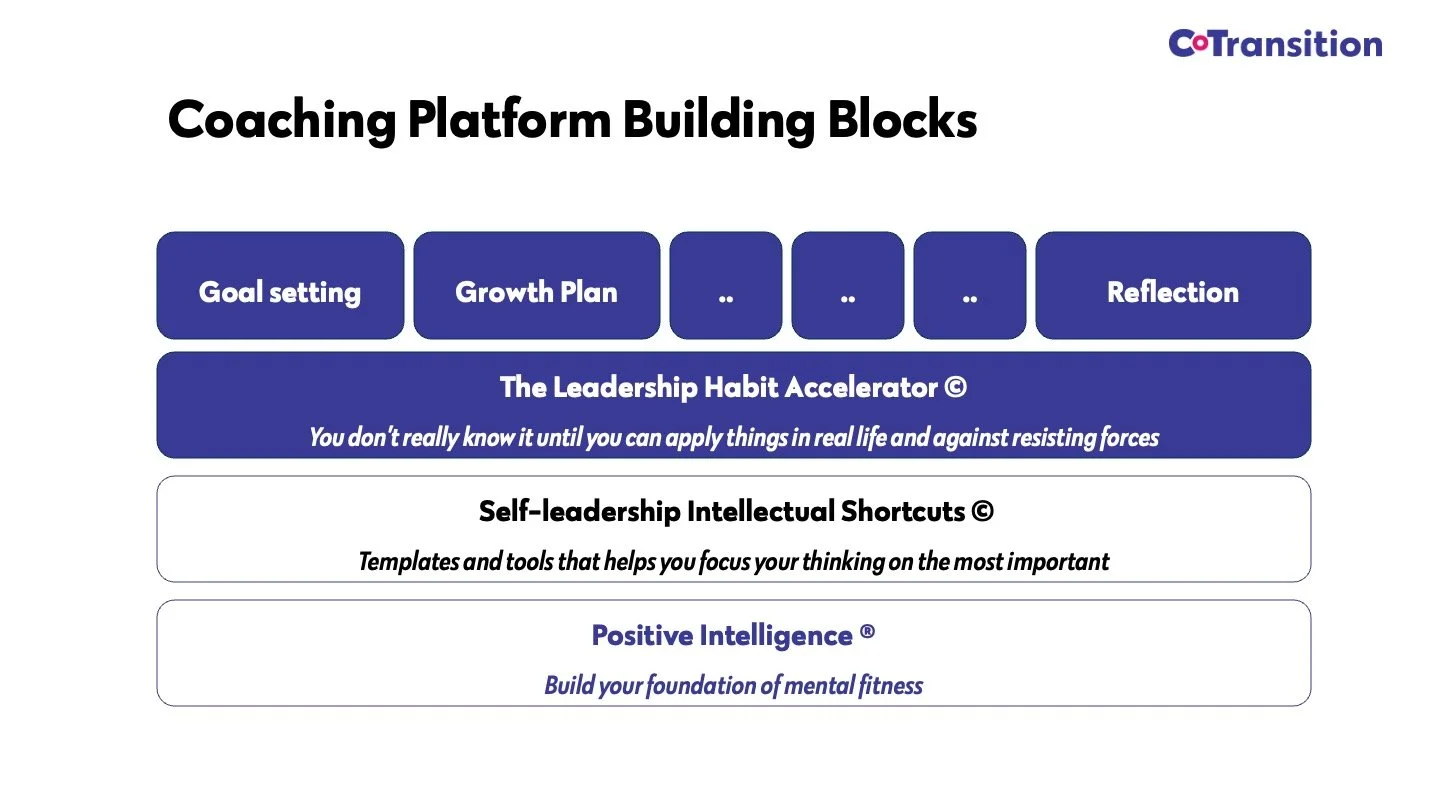
Coaching Platform Building Blocks
How an engagement works?
Meaningful leadership transformation does not happen in a single conversation. It unfolds over a structured program, as clients experiment with new behaviours, encounter resistance, and gradually integrate new ways of thinking into their daily leadership practice.
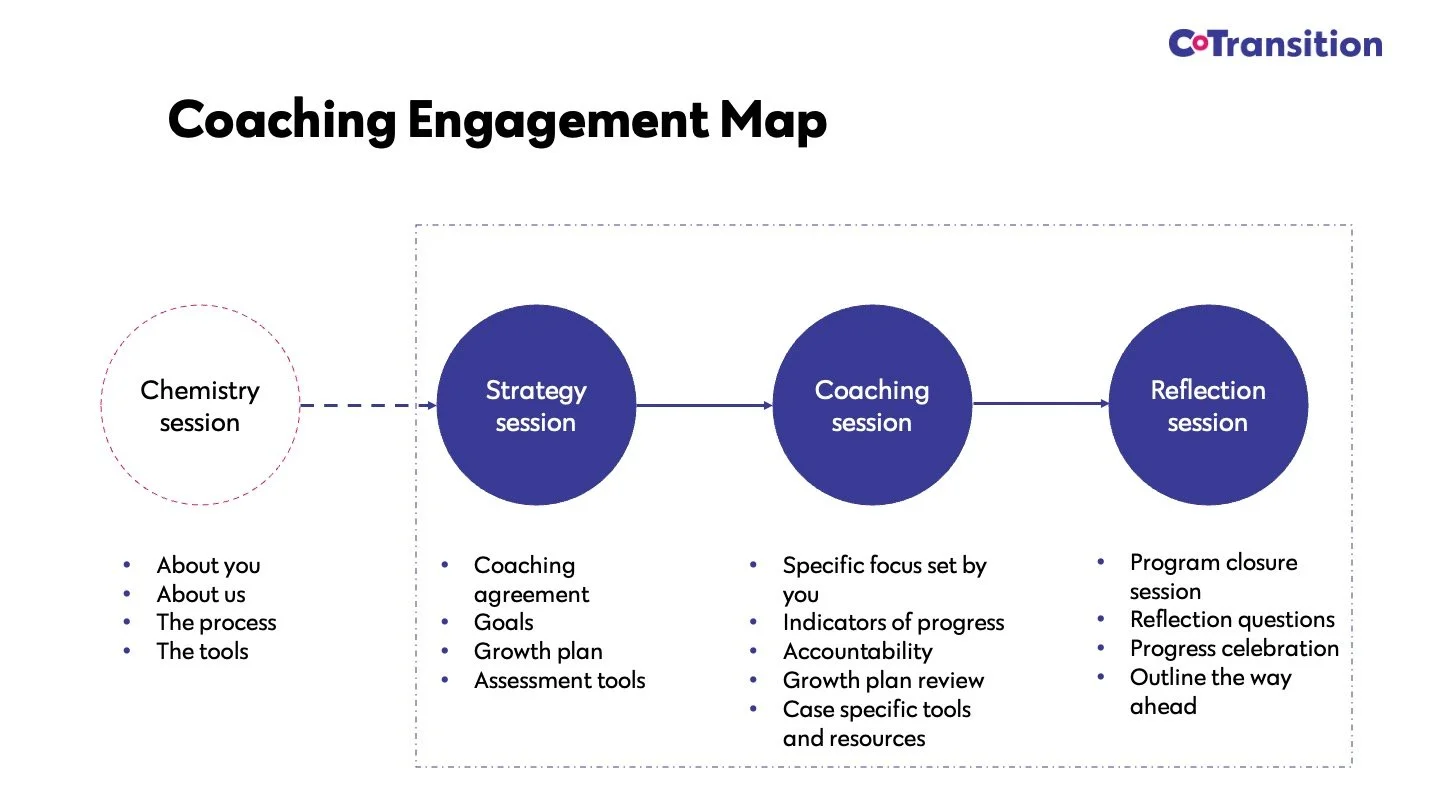
Coaching Engagement Map
Before each engagement, we have a chemistry session. `That is an exploratory conversation to understand who you are, what you are working toward, and whether we are a good fit.
From there, during a s strategy session we co-create an individual learning plan tailored to your context, goals, and growth edges. Each session is followed by a brief reflection in the days after.
The engagement may draw on various resources including tools, assessments, videos, books, and articles. Mentorship and feedback are woven throughout. The process follows the fundamentals of good coaching: goal setting, strategies, actions, and regular review.
What happens in a session?
Every session begins with you. In advance I ask what you want to focus on, what result you are looking for, and what success would look like by the end of our conversation. This is not a formality. You set the agenda. My role is to serve it with the best questions, observations, and provocations I can offer.
A typical session moves through several layers. We start with the surface challenge: the task, the decision, the stakeholder situation. We then explore your thinking and feeling about that challenge: what beliefs are at play, what assumptions are being made, what emotions are present. And we often arrive at the identity layer: who are you choosing to be in this moment, and who do you want to become?
Typical topics
While every client is unique, certain themes recur with remarkable consistency.
The transition from doing to leading.
Technical professionals who step into leadership roles often struggle with the shift from being valued for their own output to being valued for the output of others. They hold on to operational tasks longer than necessary, partly because those tasks feel familiar and controllable, and partly because letting go feels like losing a piece of their identity. My work is to help them see that this transition is not a loss. It is an expansion.
Perfectionism
Many of my clients are high achievers who hold themselves to exacting standards. This perfectionism can be a strength, but it can also become a saboteur, slowing down decisions, preventing delegation, and creating an internal narrative of never being good enough. In our sessions, we explore where perfectionism serves the leader and where it holds them back.
The courage to ask for help.
Leaders, especially in technical environments, often carry an unspoken belief that asking for help is a sign of weakness. A powerful breakthrough comes when clients realise that this belief is self-imposed, and that their managers, peers, and teams are often willing to support them when asked. Learning to ask is an act of vulnerability and trust that deepens relationships and accelerates growth.
Balancing ambition with presence.
Perhaps the most human theme of all is the tension between professional ambition and personal life. Rather than offering simplistic advice about setting boundaries, I help clients explore what balance actually means for them, what trade-offs they are willing to make, what values are non-negotiable, and how to communicate their needs with radical candour to the people who matter most.
Sessions close with integration. I invite you to name what you are taking away, what has shifted in your understanding, and what concrete step you will take next. This is not accountability for its own sake. It is a practice of self-leadership - of owning your own growth.
Who this is for?
My coaching is designed for high-potential professionals who are stepping into or growing within leadership roles. Typical clients include managers, team leads, product managers, and directors - people who have earned their seat through technical excellence and are now discovering that leadership asks something different of them.
But your job title will not determine whether I am a good fit. I look for clients who are responsible for building something, being it a team, a product, a culture, or all three. They should view coaching as an investment in becoming better at that work and help them achieve bigger and better future.
If you want someone to hand you a checklist, I am probably not the right coach for you (although the engagement is very structured ). If you want someone who will help you think more clearly, feel more grounded, and lead more deliberately, we should definately talk.